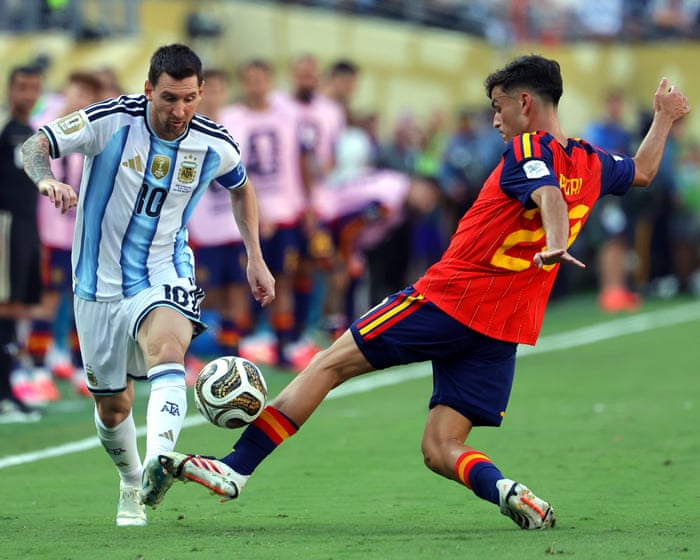
The World Cup final between Spain and Argentina proved to be a battle not just of skill but of contrasting philosophies. While Argentina aimed to transform the match into a physical contest, Spain's dedication to their possession-based style ultimately secured their victory.
Contrasting Strategies: Physicality vs. Possession
As the match commenced, it was clear that the two teams had vastly different approaches. Argentina, led by coach Lionel Scaloni, sought to disrupt Spain’s rhythm. Their game plan was to inject physicality into the proceedings, aiming to unsettle the Spaniards and nullify their fluid passing game. This strategy was facilitated by referee Slavko Vincic of Slovenia, whose lenient approach allowed the match to be played at the limits of physicality.
Early in the first half, Argentina's Alexis Mac Allister set the tone with a robust challenge on Spain's Dani Olmo. Despite the aggressive play, the referee opted not to issue an early booking, which seemed to encourage Argentina’s strategy. The South American side capitalized on the pitch conditions which were not ideal for Spain's slick passing game, further leveling the playing field.
Spain's Perseverance
In contrast, Spain maintained their focus on controlling possession and dictating the tempo. Their patience and commitment to their style was evident, even as the first half offered little in terms of goal-scoring opportunities. The question loomed whether the half-time entertainment might outshine the on-field action. However, Spain remained undeterred, avoiding the temptation to engage in a physical battle that would play into Argentina’s hands.
Spain's strategy was not without its challenges. The team had to navigate Argentina's aggressive play without losing composure. Their ability to absorb pressure and maintain their game plan was crucial. As the match wore on, Spain’s strategy began to pay dividends. They gradually wore down their opponents, who struggled to maintain their physical intensity.
Turning the Tide After Half-Time
With the second half underway, Spain increasingly found their rhythm. The Spanish players, displaying remarkable tactical discipline, began to exploit spaces and control the game more effectively. Their approach required patience, but it eventually unpicked Argentina's defense, which had been stretched by their physical exertions.
Spain's perseverance was ultimately rewarded as they managed to break through Argentina's defenses, securing a decisive advantage. The Spanish side's technical prowess and strategic patience were crucial, highlighting the effectiveness of their possession-based strategy over Argentina's reliance on physicality.
Conclusion: A Victory for Tactical Discipline
In the end, Spain's triumph in the World Cup final was a testament to the power of tactical discipline and strategic patience. Their refusal to be drawn into a physical confrontation ensured that they could play to their strengths. By sticking to their game plan, Spain demonstrated that mastery of possession football can prevail even in the face of intense physical pressure.
While Argentina's approach made for a tense and scrappy encounter, it was Spain's commitment to their style that ultimately decided the outcome. Their victory is not just a win for the team but a validation of the possession-based philosophy that has been the hallmark of Spanish football success over recent decades.