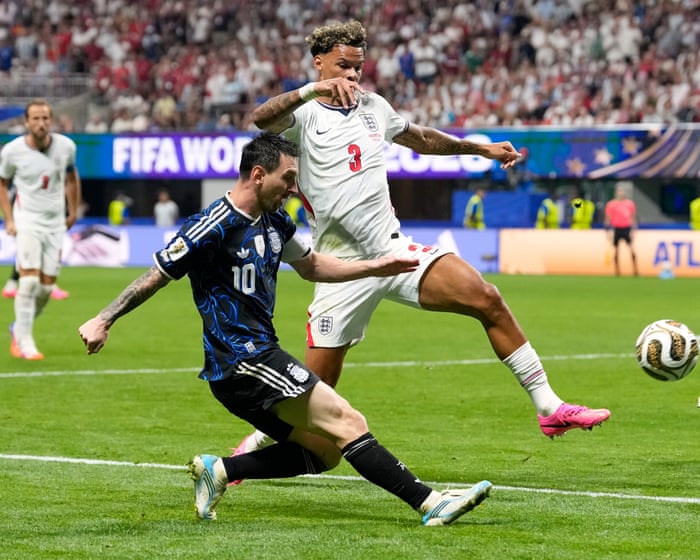
In a strategic encounter between England and Argentina, Lionel Messi, the Argentine maestro, found himself surprisingly constrained for much of the match. England's preparation, under the guidance of manager Thomas Tuchel, seemed to effectively neutralize Messi’s typically formidable presence on the field.
A Tactical Chess Match
Thomas Tuchel, known for his meticulous planning, had devised a comprehensive strategy to maintain England's balance between attack and defence. The plan included detailed contingencies for different scenarios, such as taking an early lead or facing an early deficit. Central to this strategy was the challenge of subduing Lionel Messi, whose ability to alter the course of a match is unmatched.
For the first 60 minutes, England's approach was highly effective. Messi was largely kept out of threatening positions, as evidenced by the match statistics. His involvement in the critical central areas of the penalty box was minimal, with a notable interception by Elliot Anderson nullifying a rare opportunity for the Argentine star shortly after Anthony Gordon's goal put England ahead.
Messi's Limited Impact
The data from the game highlighted Messi’s limited influence. His sprinting—defined by FIFA as speeds of at least 20km/h—constituted only 4.3% of the distance he covered during the match. This figure was notably lower than his previous performances against Switzerland (4.6%) and Egypt (5.4%), indicating how effectively England restricted his movement and participation in high-speed plays.
The Turning Point
However, the dynamics shifted following a subtle yet decisive change in Argentina’s setup. This adjustment seemed to unlock Messi's potential, enabling him to find space and exert a greater influence on the game. The previously subdued Messi began to find pockets of space, linking play and creating opportunities that had been scarce in the first hour.
"It was a game of patience and tactical discipline," observed a football analyst. "England had Messi contained until the Argentines made a slight adjustment that allowed him to impact the match more significantly."
Conclusion
The clash between England and Argentina showcased the intricacies of tactical football at the highest level. England’s initial success in negating Messi's impact underscored their preparation and strategic execution. Yet, Argentina’s ability to adapt and facilitate Messi’s influence in the latter stages highlighted the ever-present threat he poses, emphasizing the fine margins that can dictate the outcome of such high-stakes matches.
In the end, while England's strategy initially kept Messi in check, the Argentine's brilliance, facilitated by a tactical tweak, proved pivotal in shifting the momentum. This encounter serves as a testament to the constant chess match that is elite football, where a single adjustment can turn the tide of a game.